A founder I know spent two weeks rehearsing her pitch. Delivery was clean, the story landed, the demo worked. Then she submitted the deck, and the deck said none of it. The customer she talked about on stage wasn't named on a slide. The retention number she quoted out loud lived only in her head. Everything that made her convincing in the room evaporated the moment the room wasn't there.
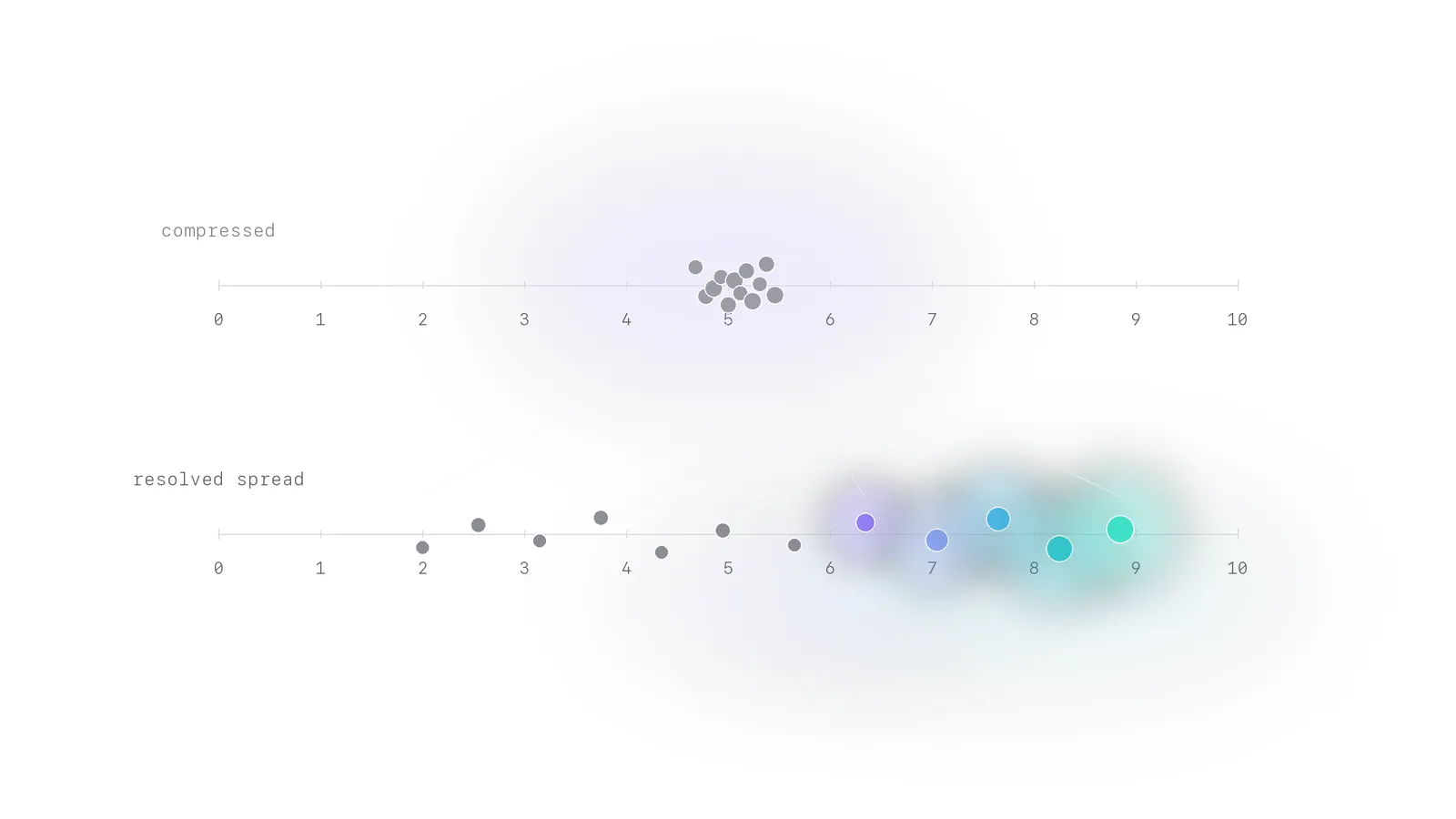
That's the gap this guide closes. When you enter our competition, your deck gets read on its own — carefully, against a consistent standard, before anyone hears you speak. The founders who do best aren't the ones with the slickest slides. They're the ones who prepared the deck to be convincing without them standing next to it.
Here's how to be one of them.
Prepare for the stranger, not the room
Most pitch advice assumes a room: read the judges, adjust on the fly, win them over. Useful for the live round. Useless for the first read, because the first read has no room. A structured evaluation reads what's on the slide, checks it against a fixed set of criteria, and writes down why — the same way for every entry, whether you're first in the batch or hundredth.
That sounds colder than it is. It's actually the fairest deal a founder gets. The reader has no memory of your last raise, no bias about where you studied, no founder it liked better yesterday. It has your slides and a rubric. Learn to write for that reader and you earn a score you didn't have to hope for.
One line holds the whole guide together:
A claim is only worth the evidence a stranger could verify without you in the room.
Everything below is a way of acting on that sentence.
Before you touch a slide: read the brief
The fastest way to lose points is to answer a question nobody asked. Before you polish anything, get the rules straight. What's the format and slide limit? Is there a time cap for the live round? What is the competition actually optimizing for — early traction, research depth, social impact, revenue?
Ask the organizers directly how entries are scored, and what a strong submission looks like to them. This isn't cheating; it's basic preparation, and experienced judges tell founders to do exactly this — "ask questions of the organizers about how the pitch competition is going to be scored, and know before you go on stage the specific aspects that the organizers are looking for" (SCORE). A deck aimed at the wrong target is a good deck with the wrong score.
Pitch to your stage, not past it
Here's a mistake that quietly sinks strong teams: pitching like a company two stages ahead of the one you are. A serious read judges you against the stage you're actually at — idea, prototype, early traction, growth — not against some universal ideal. And that's good news, because it means you're not penalized for what your stage hasn't reached yet.
The trap is trying to borrow the credibility of a later stage. A pre-revenue team that shows five-year revenue projections instead of evidence of customer learning doesn't look ahead of the curve — it looks like it's papering over the proof it should have. Missing revenue at the idea stage is normal. Missing any sign that you've talked to a real user is not.
So state your stage plainly, and bring the proof that stage can actually produce. Idea stage: sharp problem evidence and customer discovery. Prototype: the core mechanism working, even roughly. Early traction: real usage, with dates. Whatever you claim, you'll be read as that stage — say you're at $150K in recurring revenue and you'll be judged by a growth-stage bar, so be sure you can stand on it.
Make every claim checkable
This is the single highest-leverage habit, so slow down here.
For every claim on your deck, ask one question: could a stranger confirm this without me? An assertion isn't evidence. "Strong retention" is an assertion. "94% net revenue retention over the last two quarters" is a fact — specific, current, measurable, and tied to a source. The closer your claims sit to that second form, the higher a careful reader can score them.
Turning an assertion into evidence is usually small work:
- Name names. "A large enterprise customer" is a hope. "Acme, live since March" is a fact. Real logos, real segments, real people.
- Put the number next to the claim. Don't say "strong growth" on slide four and hide the number on slide nineteen. The reader shouldn't have to assemble your case for you.
- Give every metric a denominator and a timeframe. "10× better" than what? "Growing fast" over what period? A number with nothing to divide by or measure against reads as decoration. If you say 10×, show the two figures behind it.
- Date anything that can go stale. Team, customers, revenue, pipeline, partnerships, roadmap — time-sensitive claims lose weight when they're old and unconfirmed. "Partnered with X" from eighteen months ago, with no update, reads weaker than a smaller thing that's current. Put the date on it.
- Don't make one proof carry the whole deck. A single pilot can support your problem, your demand, and your team's execution — but only if you explain what it proves in each place. Leaning the entire case on one logo is fragile; a reader discounts a signal doing too many jobs at once.
The test isn't whether the claim is true. It's whether a skeptical stranger can see that it's true. Ambition without evidence rounds down; a modest claim you prove rounds up.
The five gaps that cap you no matter what
Most weak slides just cost you a little. A few gaps are different: they're structural holes that hold the whole entry down, however good the rest looks. Think of them as the load-bearing walls of a pitch. Check that each one is unmistakably present:
- A real user in pain. Someone specific who suffers the problem — not "the market," a person or role.
- A mechanism. How the product actually relieves that pain, stated plainly. Not "AI-powered." How.
- Someone who pays. A named buyer or payer. A big audience that never opens its wallet isn't a business.
- A technical owner — if you're building something technical, a person on the team who can actually build it.
- An owner for your next milestone. Not just a roadmap, but who is accountable for the next thing that has to happen.
None of these is exotic. That's the point — they're so basic that founders assume they're obvious and leave them implied. A structured read doesn't fill gaps in your favor. If it can't find the payer, there is no payer. Make all five impossible to miss.
Cover the whole story, not just the exciting part
Founders over-invest in the part they love — usually the product — and leave holes everywhere else. A structured read notices holes. It expects the full arc of a business, and a missing piece reads as a gap, not a mystery it will fill in your favor.
Walk your deck against the standard set and make sure each one is genuinely present, not just implied:
- Problem — a named user, how often the pain hits, what it costs.
- Solution — one clear mechanism, and the thing rivals can't easily copy.
- Market — a reachable first segment and who actually pays, sized from the bottom up.
- Business model — a real price for the real buyer, and a first channel.
- Traction — what actually happened, with dates and figures.
- Team — each founder's link to this problem, and something you've shipped.
- Roadmap — sequenced milestones, matched resources, and the risks named out loud.
- Financials — the unit economics, runway, and projections that make the plan add up.
- The ask — specific, and tied to what it unlocks.
You don't need a beautiful slide for each. You need each one to exist and to carry evidence. One habit worth stealing: a slide that reviewers spend too long on is usually a slide that failed to make its point, not one that impressed them. And don't quietly drop the financials — an unglamorous slide is still a slide the reader looks for, and its absence is loud.
Make it read fast
Findable beats thorough. Your best evidence helps you only if the reader actually reaches it — and readers, human or otherwise, don't read patiently. Investors spend roughly three minutes on a first pass at a deck, and only about 58% make it to the last slide (DocSend). If your best number is on slide nineteen, assume it was never seen.
A few craft habits do most of the work here:
- Let each headline state the conclusion. Not "Market" — "A $2B wedge we can reach through one channel." The slide title should carry the point even if someone reads nothing else.
- One message per slide. If a slide makes three arguments, it makes none. If it takes more than about thirty seconds to parse, it's too dense.
- Cut decorative junk. Stock imagery, 3D chart effects, and background textures don't read as thorough — they bury the one thing you wanted seen. Anything on the slide that isn't carrying meaning is working against you.
- Make charts honest and legible. Label the axes, give units, show the timeframe, name the source, and don't truncate an axis to flatter a trend. A chart should answer one question at a glance.
And resist the instinct that a dense, busy slide looks more "complete." It doesn't score better — it reads worse. A sparse slide that lands one clear point beats a full one every time, even though the full one feels more impressive to build.
One place to spend your effort: the team slide. Funds keep spending more time there, prioritizing people in an AI-heavy landscape (Dropbox DocSend). Say why this team builds this thing — from lived experience, hard-won insight, or direct access to the customer, not just titles and logos. Pedigree is not fit.
Then prepare for the questions
Here's the part founders miss, and it's the most reassuring part. The structured read doesn't hand down a verdict. It prepares the analysis — scores each area, shows the evidence behind it, and surfaces the questions a reviewer should ask you. Then a person makes the call, and the final ranking is built from human judgment, not a machine's number. AI prepares the analysis; the final call is always human.
So your deck earns the shortlist, and the room earns the win. That means two jobs, not one. Write the deck to survive a cold, literal read — that's what gets you considered. Then prepare for the conversation that read will raise, because judges weigh how well you handle it: "judges look to see how well they've prepared for the questions... and if they are responding to the questions directly" (SCORE). Rehearse the hard questions, especially the ones your own weakest slide invites. Answer the question asked, not the one you wish they'd asked.
The pre-submission checklist
Run this against your deck before you upload it:
- Every claim has evidence a stranger could verify without me.
- My best number sits next to the claim it supports, and every metric has a denominator and a timeframe.
- Every time-sensitive claim is dated; nothing important is stale and unconfirmed.
- All five load-bearing walls are unmistakable: a real user, a mechanism, a payer, a technical owner, a next-milestone owner.
- Every area of the arc is present — including financials — not just the product.
- My strongest proof is early, not buried; no slide takes thirty seconds to parse.
- Every headline states a conclusion, and every chart has units, dates, and a source.
- The team slide says why this team, with proof.
- I'm pitching the stage I'm actually at, with proof that stage can produce.
- I can answer the three hardest questions my deck invites.
None of this is about gaming a score. It's the opposite. Because the read is consistent, there's no lucky day and no reviewer to charm — you can't win on polish, logos, a famous category, or a big TAM. The only way up is to put more on the slide. That's good news. It means preparation, not persuasion, is what wins.
Reviewers forgive an ugly slide. They rarely forgive a number they can't check.
Want to see how your deck reads before it counts? Try the live demo and run it through the lens yourself first.